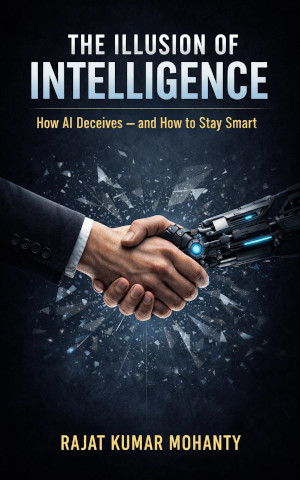
AI Sounds Intelligent.
It Understands Nothing about the Real World.
It Understands Nothing about the Real World.
The structural limits of AI—and why they matter.
How to think clearly in the presence of AI.
AI is not just a technology problem. It is a cognitive problem.
The real risk is not that AI will become intelligent — but that humans will stop thinking.
If you have ever read an AI-generated answer and felt convinced — without knowing why — this book is for you.
This is not a book about rejecting AI.
It is for curious readers who want to use AI without surrendering their judgment, while retaining control over their own thinking.
Selected excerpts — explore how the illusion unfolds, from concept to consequence to practice.
In a classroom, a student answers a difficult question. She speaks clearly, her explanation unfolds in a steady, logical sequence, and she anticipates objections before they arise. Nothing visible has changed except the arrangement of words. Yet the room shifts. Authority seems to attach itself to her voice.
Now consider another student — one who hesitates, searches for words, and pauses mid-sentence. Even if this student understands the material more deeply, the hesitation weakens confidence. Certainty is trusted more readily than hesitation.
Fluency becomes a proxy for intelligence. The inference feels natural. Most of the time, it works.
For most of human history, that inference was rarely wrong.
In professional domains — law, medicine, and research — the surface of authority carries consequences. Decisions are made. Citations are trusted. Diagnoses are considered.
What happens when the markers of authority are reproduced without the grounding that once made them reliable?
The answer is already visible. A legal brief cites cases that do not exist. The format is correct. The reasoning is structured. The confidence is intact.
What appears as authority may have no foundation at all.
Prefer to read more? View full sample on Amazon
PART 1 — The Broken Signal
Why humans mistake language for intelligence
PART 2 — When the Illusion Cracks
Real-world failures: fabricated authority, confident errors
PART 3 — Why the Illusion Persuades
Psychology of fluency bias and automation bias
PART 4 — The Many Faces of AI
From text to deepfakes to decision systems
PART 5 — Staying Smart
Practical tools to resist deception
PART 6 — Living With the Illusion
Responsibility, institutions, and human judgment
No. AI predicts patterns without understand meaning or reality.
An AI hallucination is a convincing response that appears correct but has no grounding in reality—fabricated facts, citations, or reasoning.
AI does not lie in the human sense. It does not have intent or awareness.
What looks like a lie is often a confident error—a believable falsehood.
Human cognition associates fluent language with intelligence. AI exploits this bias.
AI lacks grounding, awareness, and the ability to track truth across contexts.
Read more: What is AI hallucination? · What is AI illusion?
No. It simulates intelligence through language patterns.
Confidence is part of how language is generated. It reflects fluency, not knowledge.
They are not random errors. They arise because AI predicts what sounds right, not what is true.
Yes. It can generate detailed, structured, and convincing content that is entirely incorrect.
Because fluent, coherent language has historically been a reliable signal of understanding.
No. Over-reliance leads to cognitive errors and weakens independent judgment.
As a tool for exploration—not as a source of unquestioned truth.
Improvements can reduce errors, but the underlying limitation—lack of grounding—remains.
Have feedback or thoughts about the book?
✍️ Contact the Author / Share Feedback